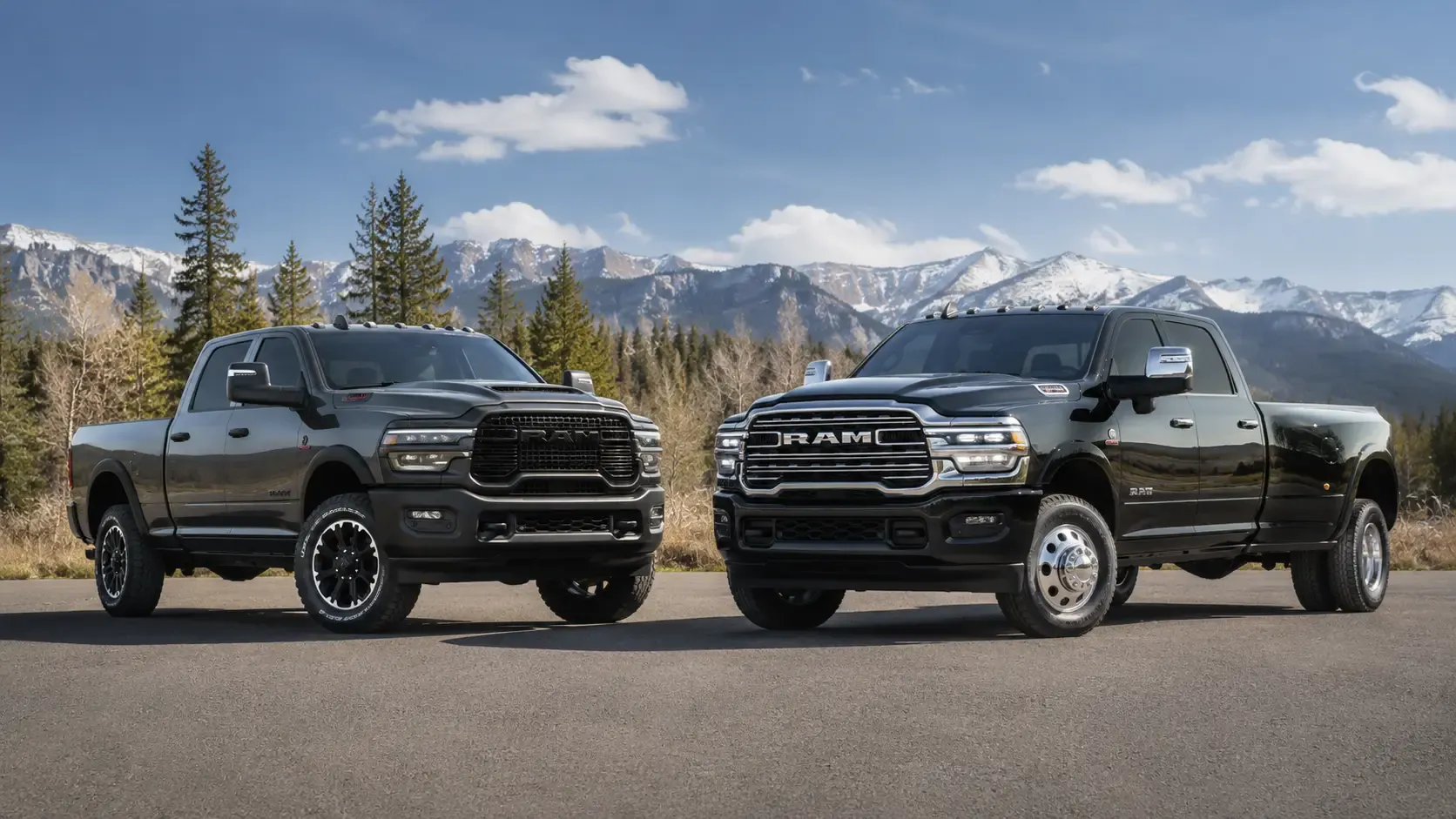
When you need a truck capable of handling demanding jobs, heavy trailers, and everyday responsibilities, the Ram 2500 and Ram 3500 are two serious contenders. Both offer powerful engine options, advanced towing technology, and versatile configurations. But choosing between them involves more than simply comparing horsepower.
The Ram 2500 is a strong option for drivers who want substantial towing capability while maintaining the versatility of a heavy duty pickup for everyday use. The Ram 3500 takes capability further with higher available towing and payload ratings, making it particularly appealing for commercial work, large trailers, and demanding hauling needs.
At M&L Chrysler Dodge Jeep Ram of Lexington, we’re breaking down the differences between the 2026 Ram 2500 and Ram 3500 to help drivers throughout Lexington, Thomasville, Salisbury, and the surrounding North Carolina communities choose the right heavy duty truck.
Ram 2500 vs. Ram 3500: The Quick Answer
Choose the Ram 2500 if: You need serious towing and hauling capability for equipment trailers, recreational towing, property maintenance, or demanding everyday work without requiring the maximum capacities of a one-ton truck.
Choose the Ram 3500 if: You regularly tow especially heavy trailers, carry substantial payloads, need available dual rear wheels, or require a truck configured for more demanding commercial applications.
2026 Ram 2500 vs. Ram 3500: Side-by-Side Comparison
Both trucks share available engine options and many technology features. Their biggest differences involve maximum towing capacity, payload ratings, and available configurations.
| Specification | 2026 Ram 2500 | 2026 Ram 3500 |
|---|---|---|
| Maximum Towing | 20,000 lbs. | 36,610 lbs. |
| Maximum Payload | Up to 4,580 lbs. | Up to 7,590 lbs. |
| Gas Engine | 6.4L HEMI V8 | 6.4L HEMI V8 |
| Available Diesel | 6.7L Cummins Turbo Diesel | 6.7L Cummins Turbo Diesel |
| Maximum Diesel Torque | 1,075 lb-ft | 1,075 lb-ft |
| Dual Rear Wheels | Not available | Available |
| Primary Advantage | Versatile heavy duty capability | Maximum hauling capability |
Manufacturer maximum ratings for the 2026 model year. Capacities vary by engine, axle ratio, cab, bed, drivetrain, equipment, and other factors. Maximum ratings are not necessarily available together. Always verify the specifications of the individual truck.
Towing Capacity: How Much Can the Ram 2500 and Ram 3500 Tow?
Towing capacity is often the deciding factor when comparing these trucks. Both are engineered for demanding towing applications, but the Ram 3500 offers considerably more capability in its highest-rated configurations.
Ram 2500 Towing Capacity
The 2026 Ram 2500 can tow up to 20,000 pounds when properly equipped with the available High-Output 6.7L Cummins Turbo Diesel engine. Gas-powered configurations equipped with the 6.4L HEMI V8 offer maximum towing of approximately 17,750 pounds.
This makes the Ram 2500 an appealing option for towing equipment trailers, recreational trailers, boats, and other substantial loads, provided the specific truck’s ratings support the trailer and cargo.
For drivers who tow periodically rather than at maximum capacity every day, the Ram 2500 may provide the right balance of capability and practicality.
Ram 3500 Towing Capacity
The 2026 Ram 3500 offers a maximum available towing capacity of 36,610 pounds with the High-Output 6.7L Cummins Turbo Diesel engine and the appropriate configuration.
Its higher available ratings make the Ram 3500 especially attractive for large fifth-wheel trailers, gooseneck trailers, heavy equipment, and commercial hauling applications.
However, not every Ram 3500 can tow the maximum advertised amount. Cab configuration, rear-wheel setup, axle ratio, hitch equipment, and payload requirements all affect actual towing capability.
Important: Towing Capacity Isn’t the Only Number That Matters
Before selecting a truck, consider the trailer’s fully loaded weight, tongue or pin weight, passengers, cargo, hitch equipment, and the truck’s Gross Combined Weight Rating (GCWR). A truck can have sufficient advertised towing capacity but still exceed its payload or axle ratings. Always review the specific vehicle’s certification labels and manufacturer towing guide.
Payload Capacity: Which Ram Truck Can Carry More?
Payload refers to the weight a truck can carry, including passengers, cargo, and applicable trailer tongue or pin weight. For many heavy duty truck buyers, payload is just as important as towing capacity.
The Ram 2500 offers substantial payload capacity for tools, supplies, equipment, and everyday work. The Ram 3500 provides a higher maximum payload rating, making it especially useful when carrying heavy loads or supporting the pin weight of a large fifth-wheel trailer.
For example, a trailer with a loaded weight of 15,000 pounds and a hypothetical 20% fifth-wheel pin weight would place approximately 3,000 pounds on the truck before accounting for passengers, hitch hardware, and additional cargo.
That example illustrates why shoppers considering large fifth-wheel trailers should carefully compare the actual payload ratings of Ram 2500 and Ram 3500 configurations rather than relying on towing capacity alone.
Ram 2500 vs. Ram 3500 Engines: Gas or Cummins Diesel?
Both 2026 Ram Heavy Duty trucks offer two powerful engine choices. The right engine depends on how frequently you tow, the weight of your loads, and your overall ownership priorities.
6.4L HEMI V8 Gas Engine
The 6.4L HEMI V8 produces 405 horsepower and 429 lb-ft of torque. It provides strong performance for towing, hauling, and everyday driving without requiring a diesel powertrain.
A gas-powered Ram Heavy Duty truck may appeal to drivers who tow less frequently, prefer a lower initial powertrain cost, or want a capable work truck for a variety of daily tasks. Actual ownership costs depend on usage, maintenance, and fuel prices.
6.7L Cummins High-Output Turbo Diesel
The available 6.7L Cummins High-Output Turbo Diesel produces 430 horsepower and 1,075 lb-ft of torque. Its substantial torque output makes it particularly well suited for demanding towing applications.
Drivers who regularly pull heavy trailers, travel long distances with substantial loads, or require the highest available towing ratings may benefit from the diesel engine. Consider the additional purchase cost and diesel-specific maintenance requirements when comparing options.
Single Rear Wheel vs. Dual Rear Wheel: What’s the Difference?
One of the most important differences between the Ram 2500 and Ram 3500 is the availability of dual rear wheels, often called a dually configuration.
The Ram 2500 uses a single-rear-wheel configuration. The Ram 3500 offers both single-rear-wheel and dual-rear-wheel configurations, depending on the selected model.
A dual-rear-wheel Ram 3500 can provide greater rear-axle load capacity and additional stability when carrying substantial loads. This can be especially useful for heavy fifth-wheel trailers and commercial applications.
The tradeoff is a wider truck that may be less convenient in parking lots, narrow driveways, and everyday driving situations. If you don’t need the additional load capacity, a single-rear-wheel truck may be more practical.
Which Ram Heavy Duty Truck Is Better for Everyday Driving?
Heavy duty trucks aren’t exclusively for job sites. Many owners also use their pickups for commuting, family travel, and everyday errands.
The Ram 2500 can be an appealing choice for drivers who need a truck capable of working hard during the week while remaining practical for personal use. Its available rear suspension technology and towing features provide options for different driving needs.
The Ram 3500 is also available with comfortable interiors and modern technology, but configurations designed for maximum hauling may feel firmer when unloaded. Dual-rear-wheel versions also require additional space for parking and maneuvering.
If your truck will spend more time commuting than towing, compare ride comfort, maneuverability, cab size, and parking convenience during a test drive.
Technology and Towing Features
Both Ram Heavy Duty trucks offer technology designed to make towing and everyday driving more manageable. Depending on the trim and equipment package, available features include:
- Uconnect touchscreen infotainment systems
- Available trailer camera views and monitoring technology
- Available Trailer Reverse Steering Control
- Available Trailer Tire Pressure Monitoring
- Available integrated trailer brake controller
- Available fifth-wheel and gooseneck towing preparation
- Available driver assistance and parking technologies
Feature availability varies by trim and configuration. When shopping for a truck, verify that the individual vehicle includes the towing equipment and technology needed for your intended application.
Which Truck Is Better for North Carolina Drivers?
From construction and landscaping work around Lexington and Thomasville to hauling equipment across Davidson County or towing recreational trailers toward the North Carolina mountains, local drivers have a wide range of heavy duty truck needs.
For Contractors and Property Owners: Ram 2500
If you frequently carry tools, building supplies, landscaping equipment, or moderate trailers, the Ram 2500 may provide the capability you need without moving to a higher-capacity Ram 3500 configuration.
For Large Fifth-Wheel and Gooseneck Trailers: Ram 3500
If you tow a large recreational trailer, livestock trailer, or heavy equipment trailer, the Ram 3500’s higher available payload and towing ratings may make it the better choice. Compare actual loaded trailer weights and pin weights before selecting a configuration.
For a Combination of Work and Personal Driving: Ram 2500
Drivers who use their truck for both job site responsibilities and everyday transportation may appreciate the Ram 2500’s combination of substantial capability and single-rear-wheel practicality.
For Maximum Commercial Hauling: Ram 3500
Businesses that regularly transport heavy materials, equipment, or large trailers may benefit from the Ram 3500’s additional available capacity. Selecting the correct configuration is essential for safe, compliant operation.
Ram 2500 vs. Ram 3500: Which Offers Better Value?
The Ram 2500 generally provides a lower entry point into the Ram Heavy Duty lineup, while the Ram 3500 offers higher available towing and payload ratings.
However, the best value isn’t necessarily the truck with the lowest price or the highest maximum towing capacity. It’s the truck that meets your actual requirements without unnecessary expense or insufficient capability.
Consider how often you’ll tow, your heaviest expected load, passenger and cargo requirements, preferred engine, and anticipated ownership costs.
You can explore financing options using our payment calculator or take the next step with our online finance application.
Frequently Asked Questions About the Ram 2500 and Ram 3500
What is the biggest difference between the Ram 2500 and Ram 3500?
The biggest difference is capability. The Ram 3500 offers higher maximum towing and payload ratings and available dual rear wheels, while the Ram 2500 provides substantial heavy duty capability in a single-rear-wheel configuration.
How much can a 2026 Ram 2500 tow?
The 2026 Ram 2500 can tow up to 20,000 pounds when properly equipped with the available High-Output 6.7L Cummins Turbo Diesel engine. Actual towing capacity depends on the truck’s configuration.
How much can a 2026 Ram 3500 tow?
The 2026 Ram 3500 offers a maximum available towing capacity of 36,610 pounds when properly equipped. Individual truck ratings vary significantly by configuration.
Does the Ram 3500 have a different diesel engine than the Ram 2500?
Both 2026 trucks offer the High-Output 6.7L Cummins Turbo Diesel engine with up to 430 horsepower and 1,075 lb-ft of torque. Their different maximum capabilities result from factors including vehicle ratings and configurations.
Is a Ram 3500 necessary for towing a fifth-wheel trailer?
Not always. Some fifth-wheel trailers can be towed by appropriately equipped Ram 2500 models. Heavier trailers, particularly those with substantial pin weights, may require the higher available payload and towing ratings of a Ram 3500.
Can you get a Ram 3500 with dual rear wheels?
Yes. The Ram 3500 offers available dual-rear-wheel configurations designed for additional load-carrying capability. The Ram 2500 is offered with single rear wheels.
Which Ram truck is better for everyday driving?
For drivers who don’t need maximum towing or payload ratings, the Ram 2500 may be a more practical choice for everyday use. The best option depends on the truck’s configuration, driving habits, and workload.
Compare Ram Heavy Duty Trucks at M&L CDJR of Lexington
Whether you’re searching for a capable work truck, a diesel pickup for towing, or a heavy duty truck for personal and commercial use, M&L Chrysler Dodge Jeep Ram of Lexington can help you explore your options.
Browse our available Ram 2500 and Ram 3500 inventory, compare configurations, and learn more about the M&L Advantage.
Serving drivers in Lexington, Thomasville, Salisbury, and surrounding North Carolina communities, our team is ready to help you find a truck that matches your towing, hauling, and everyday driving needs.